
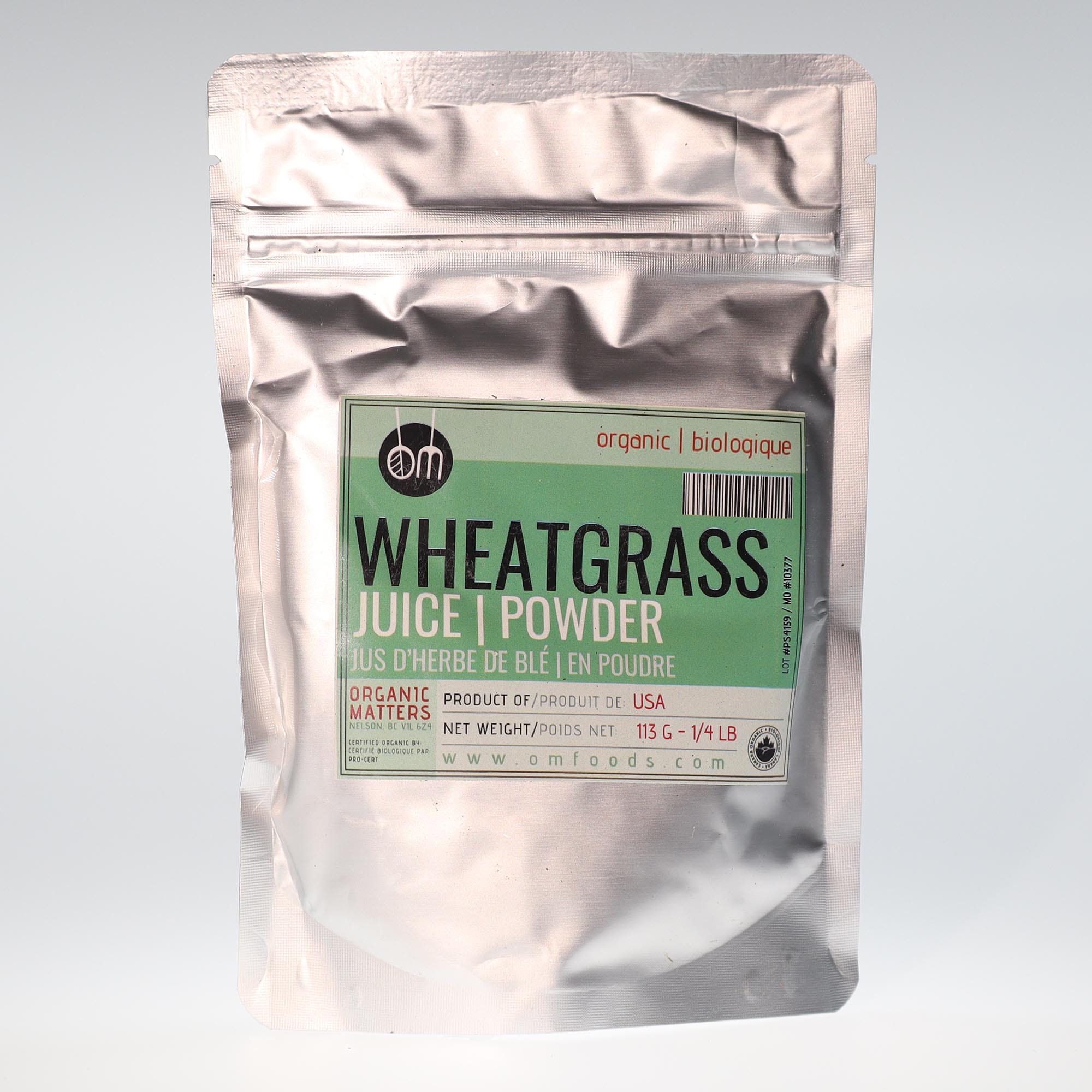
About Wheatgrass Juice Powder
Wheatgrass Juice Powder is made from the juice of young wheatgrass (Triticum aestivum), the same plant that eventually produces wheat grain.
The tender green shoots are harvested during their early growth stage, pressed to extract their juice and then dried into a concentrated, easy-to-use powder.
Wheatgrass is recognizable for its vibrant green colour, naturally occurring chlorophyll and distinctive grassy flavour.
This convenient powder can be mixed with water, juice or smoothies, providing an alternative to growing and pressing fresh wheatgrass at home.
What Makes Wheatgrass Juice Powder Different?
Wheatgrass juice powder is different from whole-leaf wheatgrass powder.
Whole-leaf powders are generally produced by drying and milling the entire grass blade, including its fibrous material.
Juice powders are produced by first extracting the liquid portion of the grass and then drying that juice.
Consequently, their composition may differ, particularly in fibre content and the relative concentrations of soluble nutrients and plant compounds.
The finished nutrient profile depends on the wheat variety, growing conditions, harvest stage, extraction process and drying method.
Chlorophyll and the Green Colour of Wheatgrass
Chlorophyll is the green pigment that enables plants to capture light during photosynthesis.
Wheatgrass contains chlorophyll alongside carotenoids, flavonoids, phenolic compounds and other naturally occurring constituents.
Chlorophyll has sometimes been compared with hemoglobin because both molecules contain a ring-shaped structure. However, their central metal atoms and physiological functions differ: chlorophyll contains magnesium, while the heme component of hemoglobin contains iron.
Consuming chlorophyll does not convert it into hemoglobin, and the presence of chlorophyll in wheatgrass does not establish that it increases blood oxygen levels.
Scientific interest in wheatgrass includes the chemistry of its pigments and their interactions with other plant constituents.
Wheatgrass Juice Powder and Nutritional Research
Wheatgrass has been investigated for its naturally occurring amino acids, vitamins, minerals and phytochemicals.
A 2022 study published in Food Research International compared juice powders produced from different wheat varieties, including conventional white wheat and pigmented wheat.
Researchers measured chlorophyll, soluble phenolic compounds, protein, amino-acid characteristics and antioxidant activity.
The study showed that composition differed considerably among varieties.
For example, the conventional wheatgrass juice powder examined in the study contained measurable chlorophyll, phenolic compounds and protein, while certain pigmented varieties contained higher concentrations of several measured constituents.
These results demonstrate that wheatgrass juice powder can contain a diverse range of naturally occurring compounds.
They do not establish the exact nutrient values of this particular product, which would require a product-specific nutritional analysis.
Research Reference
Sharma et al. (2022) – Comparison of wheatgrass juices from colored wheat (white, black, blue, and purple) for health promoting phytochemicals.
https://pubmed.ncbi.nlm.nih.gov/36192965/
Wheatgrass and Antioxidant Research
Wheatgrass contains several classes of plant compounds that have been investigated for antioxidant activity.
These include chlorophyll-associated pigments, flavonoids and phenolic acids.
In 2026, researchers published laboratory investigations of wheatgrass juice powder examining its phenolic composition and antioxidant characteristics.
The study identified several phenolic constituents, including caffeic acid and catechin, and demonstrated antioxidant activity in laboratory assays.
Laboratory antioxidant measurements provide valuable information about the chemistry of plant preparations. However, they do not establish that consuming a particular quantity of wheatgrass powder produces equivalent effects throughout the human body.
The concentrations and biological availability of these compounds also depend on the preparation used.
Research Reference
Phytochemical, in silico, and in vitro studies of wheatgrass (Triticum aestivum L.) juice powder (2026).
https://pmc.ncbi.nlm.nih.gov/articles/PMC12905174/
What Do Human Studies Tell Us About Wheatgrass?
Wheatgrass juice and related preparations have been investigated in a number of small clinical studies.
These have included research involving oxidative-stress measurements and selected gastrointestinal or blood-related conditions.
A 2015 scientific review examined the differences between laboratory findings and available human clinical evidence.
The authors observed that wheatgrass preparations contain several biologically interesting constituents, but noted that the clinical studies were generally small and had methodological limitations.
They concluded that larger, better-controlled investigations were needed before definitive clinical recommendations could be established.
This distinction is especially important because fresh wheatgrass juice, dried juice powders and other wheatgrass preparations do not necessarily have identical compositions.
Research involving one preparation should not automatically be applied to another.
Research Reference
Bar-Sela et al. (2015) – The Medical Use of Wheatgrass: Review of the Gap Between Basic and Clinical Applications.
https://pubmed.ncbi.nlm.nih.gov/26156538/
Wheatgrass and Dental Research
Wheatgrass has also appeared in preliminary research related to oral care.
A 2026 randomized clinical trial investigated a sublingually administered wheatgrass extract for short-term discomfort associated with a specific dental condition.
The study involved 45 participants and used a standardized experimental preparation.
Although researchers reported changes in pain measurements, the findings do not establish that wheatgrass juice powder repairs cavities, remineralizes teeth, reverses gum disease or replaces dental treatment.
Similarly, there is insufficient product-specific evidence to recommend wheatgrass pulling as a treatment for dental conditions.
Research Reference
Evaluation of the analgesic effect of sublingual administration of wheatgrass (Triticum aestivum) extract for dental pain management in irreversible pulpitis: a randomized clinical trial (2026).
https://pubmed.ncbi.nlm.nih.gov/41636988/
An Easy Addition to Smoothies and Juices
Wheatgrass juice powder offers a convenient way to enjoy the characteristic flavour and colour of fresh young wheatgrass without the need for a juicer.
Its naturally grassy, slightly earthy taste blends well with fruit and vegetable drinks.
It can be added to water, smoothies or fresh juices, particularly recipes containing ingredients such as pineapple, apple, lemon, cucumber or berries.
Begin with a small quantity if you are unfamiliar with the flavour.
Wheatgrass juice powder is a concentrated green food ingredient rather than a replacement for a varied diet containing vegetables, fruit, protein and other essential nutrients.
Related Green Foods
For customers exploring other plant-based green powders, consider:
Organic Spirulina Powder
https://yumnaturals.store/product/organic-spirulina-powder/
Organic Chlorella Powder 113g (Cracked Cell)
https://yumnaturals.store/product/organic-chlorella-powder-113g-cracked-cell/
Each has a different botanical origin and nutritional composition.
Product Details
Botanical Name: Triticum aestivum L.
Plant Part: Young wheatgrass shoots.
Product Form: Pressed and dried wheatgrass juice powder.
Net Contents: Confirm the current stocked package.
Organic Certification: Confirm against current supplier documentation.
Country of Origin: Listed as USA; verify current stock.
Storage: Keep tightly sealed in a cool, dry location away from moisture, direct sunlight and excessive heat.
Safety & Important Information
Wheatgrass is grown from the wheat plant. Although the young grass may contain little or no gluten when harvested before seed development, gluten-free status cannot be assumed without appropriate product-specific testing and certification.
Individuals with celiac disease, wheat allergy or gluten sensitivity should verify suitability before consumption.
Consult a healthcare professional before use if pregnant or breastfeeding or if you have a significant medical condition or take prescription medications.
Wheatgrass preparations may contain vitamin K, depending on their composition. Individuals taking warfarin or other vitamin K-sensitive anticoagulants should maintain consistent dietary vitamin K intake and seek professional guidance before introducing concentrated green powders.
Some individuals may experience nausea, digestive discomfort or allergic reactions.
Do not use this product to replace prescribed treatment or professional dental care.
Keep out of reach of young children.
Ingredient: Wheatgrass juice powder (Triticum aestivum L.). Confirm the current package for any carriers or additional ingredients.
Storage: Keep tightly sealed in a cool, dry place, protected from moisture and direct sunlight.
Cautions: Confirm suitability before use if you have a wheat allergy, celiac disease or gluten sensitivity, or if you take medications affected by vitamin K intake. Consult a healthcare professional before use if pregnant or breastfeeding.
Discontinue use if an allergic reaction or persistent digestive discomfort develops.
Keep out of reach of young children.


Reviews
There are no reviews yet.