

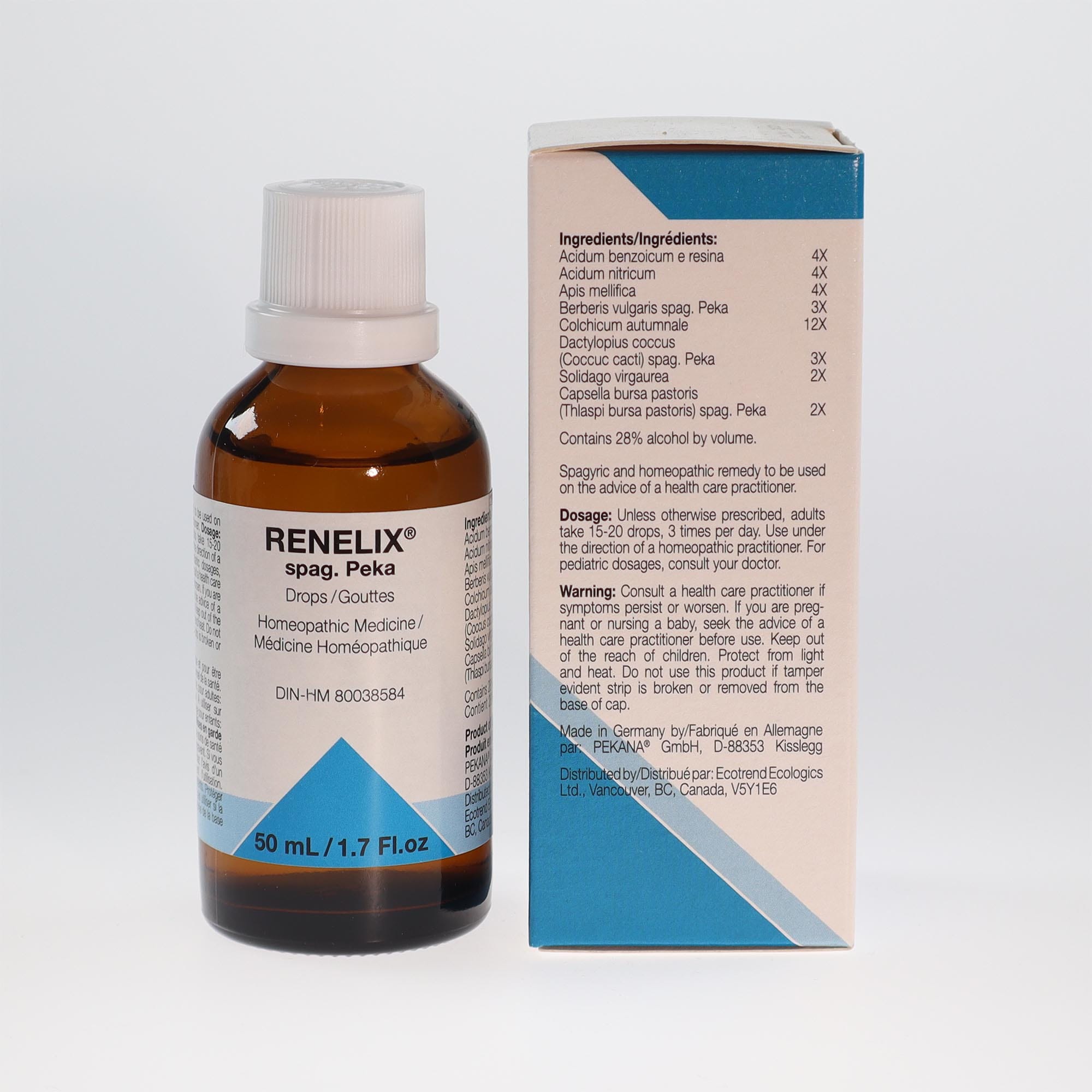
About Pekana RENELIX
Pekana RENELIX Spagyric Drops is a traditional German homeopathic combination remedy developed within PEKANA’s system of spagyric and homeopathic preparations. The formula brings together eight ingredients historically associated with kidney function, urinary elimination, fluid balance, and the body’s natural cleansing processes.
Within traditional homeopathic practice, RENELIX is associated with urinary and renal complaints, particularly constitutional patterns involving sluggish elimination, changes in urinary function, and discomfort historically linked with the kidneys and bladder.
The documented U.S. product label identifies general body cleansing and detoxification as its traditional homeopathic indication. This application is based exclusively on homeopathic experience rather than established clinical evidence.
RENELIX has not been demonstrated to improve kidney filtration, remove kidney stones, eliminate toxins, or treat kidney disease or urinary tract infections.
Traditional Homeopathic Perspective
In traditional European homeopathic and naturopathic literature, the kidneys and urinary system are considered important components of the body’s normal elimination and fluid-regulation processes. The kidneys continuously filter blood, remove many water-soluble metabolic waste products, regulate electrolyte and fluid balance, and contribute to blood pressure regulation and acid-base balance. Urine formation involves filtration, reabsorption, and secretion within specialized structures called nephrons. These functions help maintain the internal chemical environment necessary for ordinary physiological activity.
Traditional homeopathic literature discusses urinary complaints in relation to broader constitutional patterns, including changes in urine appearance, urinary discomfort, fluid retention, joint symptoms, and physical fatigue. RENELIX combines ingredients historically associated with several of these patterns. Certain ingredients are traditionally discussed in relation to urinary sediment and mineral deposits, while others appear in classical homeopathic literature concerning changes in urination, fluid retention, and musculoskeletal discomfort.
PEKANA-related practitioner literature also discusses RENELIX within traditional drainage approaches concerned with the kidneys, bladder, and the relationship between metabolic activity and urinary elimination. These references describe historical complementary-medicine practices rather than demonstrated improvements in kidney function.
What Makes RENELIX Different?
RENELIX belongs to PEKANA’s family of spagyric combination remedies, which incorporate principles of classical homeopathy and traditional European botanical preparation.
Spagyric preparation has its origins in historical herbal and alchemical traditions. The process generally involves separate extraction and processing stages, followed by recombination of selected constituents. PEKANA uses spagyric methods for certain ingredients in its homeopathic formulations.
Unlike conventional herbal tinctures that rely primarily on measurable concentrations of botanical constituents, RENELIX includes ingredients prepared at specified homeopathic potencies. Certain regional formulations also incorporate botanical preparations expressed as mother tinctures or measured quantities.
Its combination reflects the traditional homeopathic consideration of urinary function, fluid balance, metabolic waste, and constitutional patterns involving the kidneys and urinary tract.
Ingredients & Traditional Homeopathic Profiles
Ingredients: Acidum benzoicum e resina (Benzoic acid), Acidum nitricum (Nitric acid), Apis mellifica, Berberis vulgaris (Barberry), Colchicum autumnale (Autumn crocus), Dactylopius coccus (Coccus cacti), Solidago virgaurea (Goldenrod), and Capsella bursa-pastoris (Thlaspi bursa-pastoris, Shepherd’s purse). Liquid excipients include ethanol and water. Refer to the current Canadian product label for the exact homeopathic potencies, ingredient concentrations, and alcohol content.
The following potencies reflect one documented Canadian-market formulation and require confirmation against the stocked bottle.
- Acidum benzoicum e resina 4X – Traditionally associated with urinary complaints involving changes in urine odour or appearance, uric acid-related symptom patterns, and joint discomfort. Classical homeopathic literature frequently discusses its use in relation to urinary sediment and rheumatic complaints.
- Acidum nitricum 4X – Historically associated with irritation of the urinary tract, discomfort during urination, and certain mucous membrane complaints. Traditional homeopathic references include its use in symptom patterns involving burning, sensitivity, and urinary discomfort.
- Apis mellifica 4X – Traditionally associated with swelling, fluid retention, and urinary complaints involving reduced urine output or sensations of irritation. Classical homeopathic literature also describes its use in constitutional patterns involving puffiness, sensitivity, and stinging discomfort.
- Berberis vulgaris 3X – Historically associated with kidney and urinary discomfort, particularly sensations radiating from the lower back toward the abdomen, bladder, or thighs. Traditional homeopathic references frequently discuss Berberis in relation to urinary sediment, mineral deposits, and discomfort associated with urination.
- Colchicum autumnale 12X – Traditionally associated with joint discomfort, gout-like symptom patterns, and constitutional complaints historically linked with uric acid metabolism. Classical homeopathic literature describes its use in relation to sensitivity, swelling, and discomfort affecting the joints. The unprocessed autumn crocus plant is highly toxic and should not be confused with its homeopathic preparation.
- Dactylopius coccus (Coccus cacti) 3X – Traditionally associated with irritation of the mucous membranes, urinary discomfort, and certain bladder-related symptom patterns. Classical homeopathic references also discuss its use in relation to spasmodic sensations and sensitivity affecting the urinary tract.
- Solidago virgaurea (Goldenrod) 2X – Traditionally associated with kidney and urinary function, fluid balance, and complaints involving urinary sediment or discomfort. Goldenrod also has a long history in European herbal medicine, particularly in preparations concerned with urinary elimination.
- Capsella bursa-pastoris (Thlaspi bursa-pastoris) 2X – Historically associated with urinary complaints, fluid balance, and certain constitutional patterns involving the kidneys and bladder. Shepherd’s purse has a long history in European herbal medicine, while its homeopathic preparations are discussed in relation to urinary and other symptom patterns.
These ingredient descriptions reflect historical homeopathic uses and should not be interpreted as evidence that the finished combination increases kidney filtration, dissolves urinary stones, removes toxins, treats urinary infections, or improves renal function.
Important Information About Homeopathic Remedies
Homeopathy is a system of complementary medicine developed around the principle that substances associated with particular symptoms may be prepared in diluted forms for use in corresponding symptom patterns. The letter X in a homeopathic potency indicates a decimal dilution scale, with each stage representing a tenfold dilution and subsequent preparation according to homeopathic methods. Some traditional spagyric formulations contain mother tinctures or other low-dilution preparations. These may contain measurable amounts of their source substances, and their safety characteristics depend on the actual formulation.
Product Details
Brand: Pekana
Manufacturer: PEKANA Naturheilmittel GmbH, Germany
Product Form: Liquid spagyric/homeopathic drops
Net Contents: 50 mL (approximately 1.69 US fl oz)
Alcohol Content: Refer to the current Canadian product label. Some Canadian-market formulations list 28% alcohol by volume, while other Canadian and U.S. references identify 25%.
Storage: Protect from light and heat. Keep securely closed and out of reach of children.
Safety & Important Information
RENELIX is a homeopathic product whose stated traditional applications are based on homeopathic experience. It is not a substitute for medically established treatment of kidney disease, urinary tract infections, kidney stones, or other significant urinary conditions. Consult a qualified healthcare practitioner before use, particularly if you have kidney disease, impaired kidney function, urinary obstruction, or another significant medical condition, or if you take prescription medications.
Do not discontinue prescribed medications or replace recommended monitoring of kidney function with this product. Persistent urinary discomfort, blood in the urine, fever, severe back or flank pain, difficulty urinating, or significantly reduced urine output should receive prompt medical assessment. If symptoms persist or worsen, consult a licensed healthcare practitioner. If pregnant or breastfeeding, seek professional advice before use. Consult a healthcare practitioner before giving this product to children.
Do not use if you have a known sensitivity to any ingredient without consulting a healthcare practitioner. Keep out of reach of children. Do not use if the tamper-evident seal is broken or missing.
Disclaimer: These statements have not been evaluated by the U.S. Food and Drug Administration. This homeopathic product has not been evaluated by the FDA for safety or efficacy, and the FDA is not aware of scientific evidence supporting homeopathy as effective. Information provided is educational and is not a substitute for individualized medical advice.


Debra Y. –
This is a wonderful product to help with kidney care!! So thankful!! I swear by these products to help us restore our bodies!! Very happy!!☺
susan r. –
Thumbs on all the spagyric products!